What a new roof costs in Fayetteville, and why two quotes can be thousands apart
The national cost guides give you a starting range. Layers, decking, pitch, ventilation and storm history decide where a Fayetteville house lands inside it.
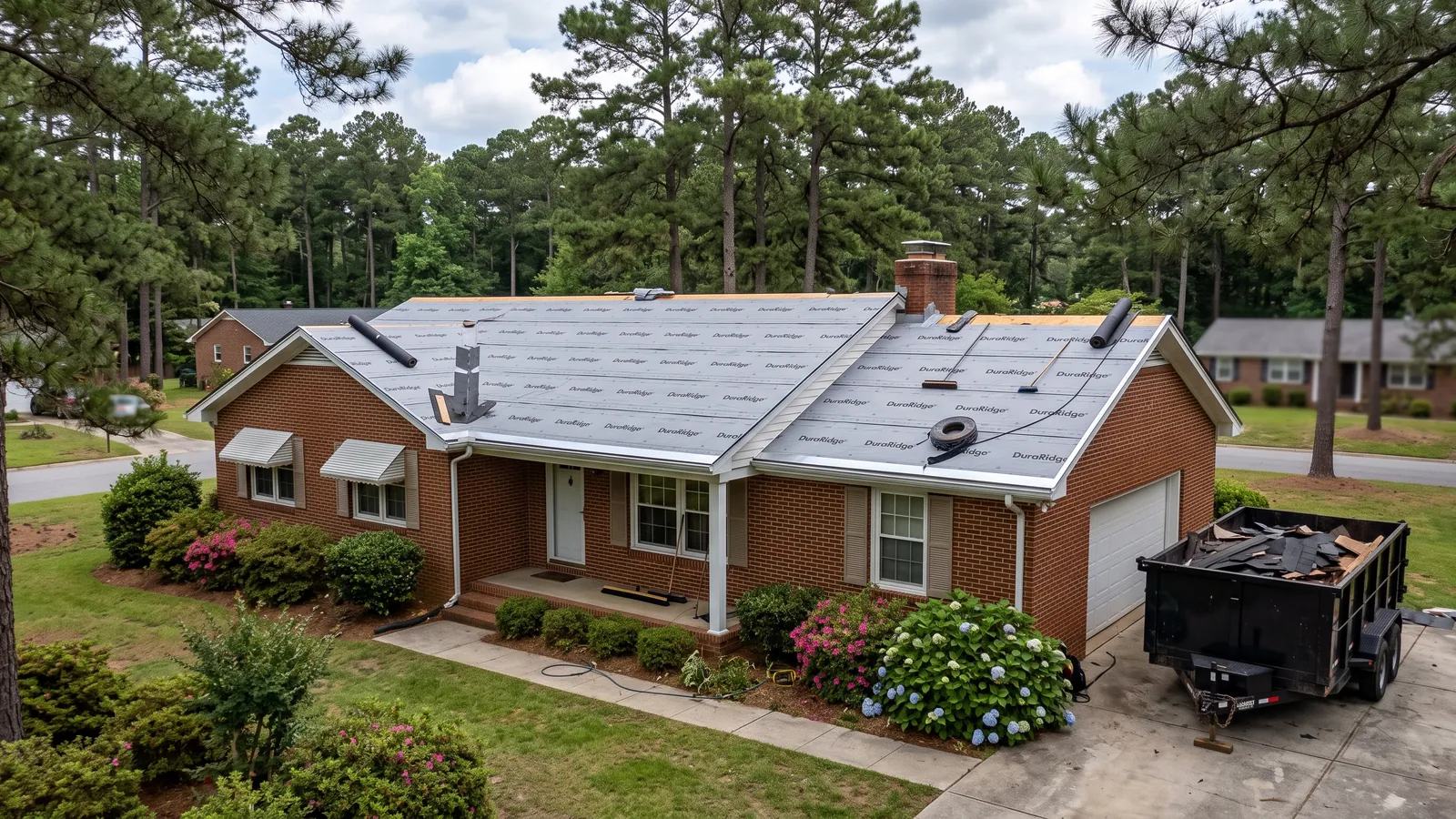
Ask three roofers for a price on the same house and you can get three numbers that are thousands of dollars apart. Some of that is overhead and margin. More of it is scope: one bid tears off two layers and replaces twenty sheets of decking, another assumes one layer and no rot, and a third quietly leaves the old box vents in place. The cheapest number is often just the smallest job.
Start with the published ranges. They're national, not local, but they're honest about the spread.
| Roof | Typical range | Source and notes |
|---|---|---|
| Asphalt shingles, 2,000 sq ft roof | $8,000 – $24,000 | HomeAdvisor; national average about $12,300 |
| Asphalt shingles, per square foot | $4.25 – $12.25 | HomeAdvisor; installed, tear-off included in most quotes |
| Standing seam metal, per square foot | $4 – $30 | HomeAdvisor; whole jobs $9,400 – $32,600, average near $19,000 |
| TPO flat roof, per square foot | $4.50 – $16 | HomeAdvisor; whole jobs $6,500 – $24,000, average $10,700 |
| New gutters with the roof | $622 – $1,677 | Bob Vila; aluminum runs $4 – $14 per linear foot |
| Skylight replaced during the reroof | $1,014 – $2,828 | HomeAdvisor install range, average $1,920 |
What pushes a Fayetteville quote up
- Layers. Some older houses carry a second roof nailed over the first. Every layer is labor and dumpster weight. If a defective roof has three or more layers, VA's minimum property rules require all of them off before the new one goes on, and FHA's guidance says the same once more than two layers need repair.
- Decking. Soft or delaminated sheathing under a long-leaking valley or chimney gets replaced sheet by sheet. A good contract states how many sheets are included and the price per sheet beyond that.
- Pitch and height. A steep two-story roof means more safety gear, slower work and more labor than a low-slope ranch.
- Ventilation. Many older roofs have a few box vents and painted-over soffits. Adding ridge vent and opening the intakes costs a little now and protects the new shingles from a hot, humid attic.
- Trim and flashing. Rotted fascia, rusted step flashing, cracked pipe boots and a chimney that needs new counterflashing are all extra lines.
- Structure. Replacing a rafter or other load-bearing framing brings a building permit into it; a straight like-for-like reroof under $40,000 usually doesn't need one under G.S. 160D-1110. We confirm with the inspections office for your address.
What should be written on the quote
A replacement quote you can hold someone to names more than a shingle color. Ours list the following, and it's a fair checklist for anyone's:
- How many layers are coming off, and what happens if there turn out to be more.
- The decking allowance in sheets, and the price per sheet beyond it.
- The underlayment: synthetic over the whole deck, plus ice-and-water membrane in valleys and around penetrations.
- New drip edge, starter strip and ridge cap, not reused pieces.
- The ventilation plan: ridge vent length, intake at the soffits, and which old vents get removed and patched.
- New pipe boots and flashing at walls and chimneys, or a note on why existing metal is staying.
- Gutter work, if any, priced on its own line.
- Cleanup, the magnet sweep and haul-off.
When two quotes list the same things, the totals usually land closer together than people expect.
Insurance jobs versus cash jobs
In our research on this market, insurance restoration jobs commonly run $12,000 to $20,000 while cash replacements land around $8,000 to $12,000. Those are different kinds of jobs, not one roof priced two ways: storm claims often cover damage beyond the shingles, while many cash jobs are planned replacements. Either way, the price should match what is actually on and under the roof, and the same roof should cost the same whoever pays.
How to compare bids
- Line up the scope first: layers removed, underlayment type, ventilation plan, flashing, drip edge and decking allowance.
- Check the shingle line and color are the same on each bid, or ask why not.
- Ask for the insurance certificate. For any project at $40,000 or more, ask for the NC general contractor licence number too.
- Read the payment terms. A deposit for materials is normal; most of the money should be due at completion.
- Get the cleanup and nail sweep in writing. Fayetteville yards and driveways deserve a magnet sweep.
A free roof check from us gives you photos and a scope you can hand to anyone else for a fair comparison.
People also ask
How long does a replacement take?
Most single-family shingle roofs here are a one- or two-day job once materials are on site. Rain moves the start date; it doesn't change the price.
Can I just put a new layer over the old one?
Sometimes it's allowed, but we rarely recommend it. You can't see the decking, the roof gets heavier, and if a VA buyer comes along and the roof is defective with three or more layers, everything has to come off anyway.
Do I need a permit?
For most single-family reroofs under $40,000 with no structural work, state law exempts the permit. Structural repair to rafters or other framing needs one. We check before work starts.
Is a cheaper bid always smaller scope?
Not always, but often. Compare layers, decking allowance, underlayment and ventilation line by line before you compare totals.
Does homeowners insurance pay for an old roof?
Insurance covers sudden covered damage such as wind or hail, less your deductible. Wear and age generally aren't covered.
Keep reading: Roof replacement · Metal or shingles? · Permits and the $40,000 line · Paying for a roof